Matter Protocol Explained for UK Smart Home Buyers in 2026
September 29, 2026•admin•8 min read
The Matter protocol is the smart home industry’s most significant development in years — a universal standard that lets devices from different brands work together without complex setup or ecosystem lock-in. If you’ve ever been frustrated that your Philips Hue lights don’t play nicely with your Google thermostat, or that buying a Nest device means committing to Google forever, Matter is the answer. Here’s everything UK buyers need to know.
What is Matter, exactly?
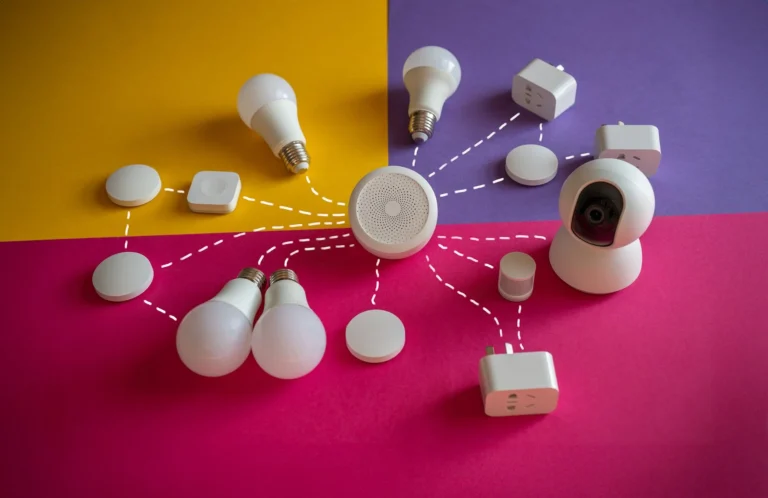
Matter is an open-source connectivity standard developed by the Connectivity Standards Alliance (CSA), backed by Apple, Google, Amazon, Samsung, and hundreds of other manufacturers. It defines a common language that smart home devices speak, so a Matter-certified light bulb can be controlled by Alexa, Google Home, Apple HomeKit, and SmartThings simultaneously — without needing separate setup for each platform.
Before Matter, buying into smart home meant choosing a platform and largely sticking to it. A Philips Hue bulb worked great with Google Home but required workarounds for Apple HomeKit. A Nest thermostat was easy with Google but awkward with Alexa. Matter removes this friction at the hardware level.
Matter device support in 2026
Device category
Matter support
Notable UK-available models
Smart lights / bulbs
Full support
Philips Hue, Ikea Dirigera, TP-Link Tapo
Smart plugs
Full support
TP-Link Tapo P125M, Eve Energy, Meross
Smart thermostats
Partial (growing)
tado° V3+, Ecobee (US-led)
Smart locks
Full support
Yale Linus, Aqara
Smart sensors
Full support
Aqara, Eve, Nanoleaf
Security cameras
Limited (in progress)
Planned for 2026 updates
Smart doorbells
Limited
Few UK-available models yet
How does Matter actually work?
Matter devices communicate over your home’s IP network — either Wi-Fi or Thread. Wi-Fi Matter devices connect to your router as normal. Thread-based Matter devices form a low-power mesh network and connect to your home network via a Thread border router (built into Amazon Echo 4th gen, Apple HomePod 2nd gen, and Google Nest Hub 2nd gen).
Crucially, Matter processing can happen locally — your devices don’t need to talk to a manufacturer’s cloud server. This means faster response times (commands fire in milliseconds rather than taking a round trip to a server in the US) and continued operation when your broadband is down.
Setup works via a QR code scan. You open any Matter-compatible app (Amazon Alexa, Google Home, Apple Home, or SmartThings), scan the QR code on the device or its packaging, and the device is added. You can then add the same device to a second platform by scanning again — a process called “multi-admin” that’s unique to Matter.
Thread: the protocol within the protocol
Thread is a low-power mesh networking protocol that runs underneath Matter for many device types. Where Wi-Fi creates a star topology (all devices connect to the router), Thread creates a mesh where devices relay signals between each other. This makes it more reliable over distance, eliminates single points of failure, and uses significantly less power — ideal for battery-powered sensors and smart TRVs.
To use Thread, you need at least one Thread border router in your home. As noted, modern Echo, HomePod, and Nest Hub devices include one. For a Thread-based smart home setup, having two or more border routers distributed around the house creates a more resilient mesh. This is something UK buyers in larger homes should consider when placing their smart speakers.
Is Matter worth buying into now?
Yes — with a caveat. Matter is the right direction, and buying Matter-certified devices today is smart future-proofing. However, the standard is still maturing. Camera support is incomplete, some thermostat implementations are basic, and not every manufacturer’s Matter implementation is equally polished. Buying a device specifically because it’s Matter-certified, when a non-Matter version from the same brand works better today, is premature optimisation.
The practical rule: when two comparable devices are similarly priced and one supports Matter, choose the Matter version. Don’t pay a significant premium solely for Matter. And don’t expect Matter to magically fix a poor-quality device — the underlying hardware still matters.
Matter and UK smart home platforms
All four major UK-accessible platforms support Matter:
Amazon Alexa: Full Matter support on Echo 4th gen and later devices.
Google Home: Full Matter support on Nest Hub 2nd gen and the Google Home app.
Apple HomeKit: Full Matter support on HomePod 2nd gen and iPhone/iPad with iOS 16.1+.
Samsung SmartThings: Full Matter support via the SmartThings app and hub.
Home Assistant: Excellent Matter support, including the ability to run a local Matter server without relying on any manufacturer’s cloud.
When shopping for smart home devices in 2026, look for the Matter logo on packaging or in product listings. In the UK, Amazon, John Lewis, Screwfix, and B&Q now routinely label Matter-compatible products. The official CSA Matter product database lists every certified device.
If you already have a smart home and are wondering whether to replace your devices with Matter versions: there’s no need to rush. Existing devices keep working perfectly. But when devices need replacing, choosing Matter gives you more flexibility going forward. And if you’re building a smart home from scratch in 2026, there’s no good reason not to prioritise Matter-certified hardware for lights, plugs, and sensors — the price premium is now minimal.
Matter and privacy
Matter includes security by design: all communication is encrypted end-to-end, device authentication uses public key cryptography, and the standard prohibits selling your data as part of the specification. This is a meaningful improvement over the wild west of earlier smart home protocols. The ICO’s guidance on smart home device privacy is worth reviewing alongside any purchasing decision — but Matter-certified devices meet a higher baseline standard than their pre-Matter equivalents.
The bottom line
Matter is genuinely transformative for the smart home industry, and UK buyers are well-served by choosing Matter-compatible devices when options are available. The freedom to change platforms, the local processing, the faster response times, and the improved security all represent real improvements over the fragmented smart home world of 2020–2023. Start with the right foundation, choose Matter where you can, and you’ll build a smart home that stays flexible for years to come.